Releases
Latest releases
- sbmlsim0.15.0
A release of the likelihood and of PEtab v2. A fit minimizes the negative log-likelihood of the noise models of PEtab or the log posterior with the priors, so the standard deviations of the noise are estimated with the parameters of the model. sbmlsim reads PEtab v2 only: the PEtab test suite (149…
- libsbgnpy0.7.2
This is a maintenance release: the dependencies are updated, the package itself is unchanged.
- pkdbv0.12.19
pkdb 0.12.19 is a security release: the pkdb package and the backend require Pillow 13.0.0, which fixes 41 advisories of the earlier releases, five of them critical, and the former upper bound <13 no longer keeps projects which depend on pkdb from taking the fix. The database needs no migration.
- pkpdutils1.4.0
Minor release of pkpdutils which makes the analysis stricter about its input, consistent in its units and bounded in its memory (#115, #116), guards the terminal regression of simulated profiles against the noise of the integrator (#117), and updates the dependencies, among them the security fixes…
- sbmlutils0.17.1
pillow>=13.0.0 is a dependency of the examples extra: matplotlib writes its images with pillow, which reaches a user of sbmlutils[examples], and pillow 13.0.0 fixes the advisories of 12.3.0 (GHSA-332p-7hrc-92wf, GHSA-8g5g-8vmr-9782, GHSA-v9pv-5gc8-w2m6, GHSA-w889-685w-c8fh and 25 more); the lock…
- pkpdbib0.2.3
The development and test tooling is locked to versions with the fixes of the advisories of its dependencies: filelock 4.2.1 (GHSA-v4x8-3wr5-3wq8, GHSA-9vhv-jxww-xfm5), virtualenv 21.14.13 (GHSA-vxj4-q4g9-crj7, GHSA-394h-qwmc-48pf, GHSA-6w3r-xr62-4xcp, GHSA-c978-59m8-c77v, GHSA-494p-63j8-28p3…
- cy3sbmlv0.9.1
- A dependency maintenance release for Cytoscape 3.10 and Java 17, with updated runtime libraries, build tools, Python helpers and documentation tooling.
- visfem0.2.0
In this release, datasets are described by JSON files and drawn by built-in renderers. It adds two public example datasets, LS-DYNA and FEBio support, documentation at visfem.de/docs, a hardened deployment and tests of the core functionality. VisFEM now requires Python 3.14.
- sbml2cellml0.4.3
Security release: the locked environment no longer trusts the compromised emSign root CA (#60).
- sbmlode0.3.1
sbmlode 0.3.1 is a security release of its development tooling: the uv with which the lock, the tests and the release are made no longer trusts the emSign root CA whose intermediate keys were compromised. The package and the code it writes are unchanged.
- roadrunnerv2.11.0
Updates: * Now released for python 3.15 (and three previous python versions, through 3.12) * Use latest SWIG for python bindings. * Update Sundials library * The absolute tolerance vector is now scaled from the initial values of the model, not the current values. This leads to more stable…
- livermetabolism-site0.12.7
A patch release that announces the certificate in science communication from TU Berlin, shows every detail image of a news item, and keeps the last verified GitHub, Google Scholar and OpenAlex figures on the site when a daily data source answers empty or implausibly.
- sbml4humans0.12.2
The python package supports Python 3.12, 3.13, 3.14 and 3.15.
- cobrapy0.32.1
fixed import failure when hopsy was not installed
- tellurium2.2.11.2
Small fix to SED-ML handling of files with paths. SimpleSEDML should now work on Windows.
Release history
Activity
Commit activity
Stars
- Python
- C++
- HTML
- Java
- JavaScript
- TypeScript
Software

PK-DB
Pharmacokinetics database
Developed the first FAIR-compliant open database for pharmacokinetics, integrating clinical and pre-clinical trial data. PK-DB enables reproducible PBPK/PD modeling, supports individualized simulations, and has become a key infrastructure for computational pharmacology research.
v0.12.19★ 5317 opentodayPythonMIT



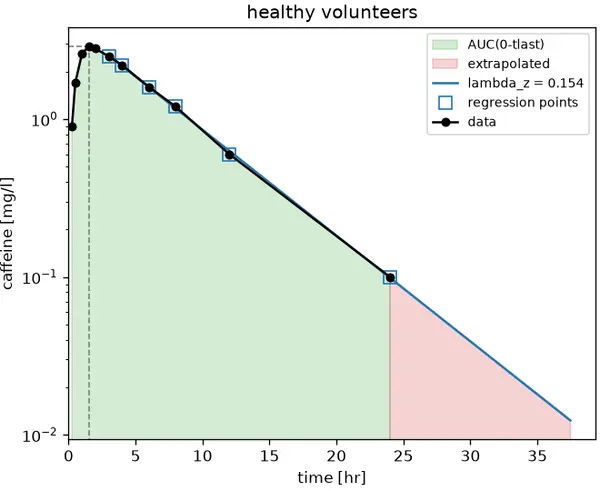
pkpdutils
PK/PD analysis in python
Developed a Python library for the pharmacokinetic and pharmacodynamic analysis of timecourses and parameters, from non-compartmental analysis and curve fitting to bioequivalence and meta-analysis. Formerly pkdb_analysis, the analysis toolbox of PK-DB.
1.4.0★ 62 openyesterdayPythonMIT

pkpdbib
PK/PD literature in python
Developed a Python library for working with pharmacokinetics and pharmacodynamics (PK/PD) literature and bibliographies, from retrieving the PDFs of a Zotero export to programmatic access to Zotero libraries. Supports the literature curation of PK-DB and of the PK/PD models built on it.
0.2.3★ 11 openyesterdayPythonMIT


SBML4Humans
SBML simulation made easy
Designed an interactive reporting framework that makes SBML models human-readable and accessible, enabling experts and newcomers to explore model content without technical barriers.
0.12.2★ 213 open3 weeks agoPythonMIT

sbml2cellml
Conversion between SBML and CellML
Built a bidirectional converter between SBML and CellML 2.0, validating every conversion with libcellml and checking it by simulation against the SBML test suite and the curated BioModels. Lets models move between the two main model description standards instead of being locked into one.
0.4.3★ 21 openyesterdayPythonMIT
sbmlode
Ordinary differential equations of SBML models
Built a Python package that derives the system of ordinary differential equations of an SBML model from its reactions, rules, events and units, and writes it as simulation code for Python, Julia and R, verified against libRoadRunner over the SBML test suite, or as Typst, LaTeX and Markdown documents of the equations. The ODE export of sbmlutils as a package of its own.
0.3.1★ 20 openyesterdayPythonMIT




roadrunner
High-performance simulator for SBML
Contributed to the development of libRoadRunner, a C/C++ library using LLVM for ultra-fast simulation of SBML models, setting a benchmark for performance in computational biology.
v2.11.0★ 6467 open2 days agoC++


tellurium
systems biology simulation library
Co-developed Tellurium, a Python-based environment for reproducible dynamical modeling of biological networks. Integrated standard formats with powerful simulation libraries, enabling accessible and transparent modeling.
2.2.11.2★ 148135 open2 months agoPythonApache-2.0
VisFEM
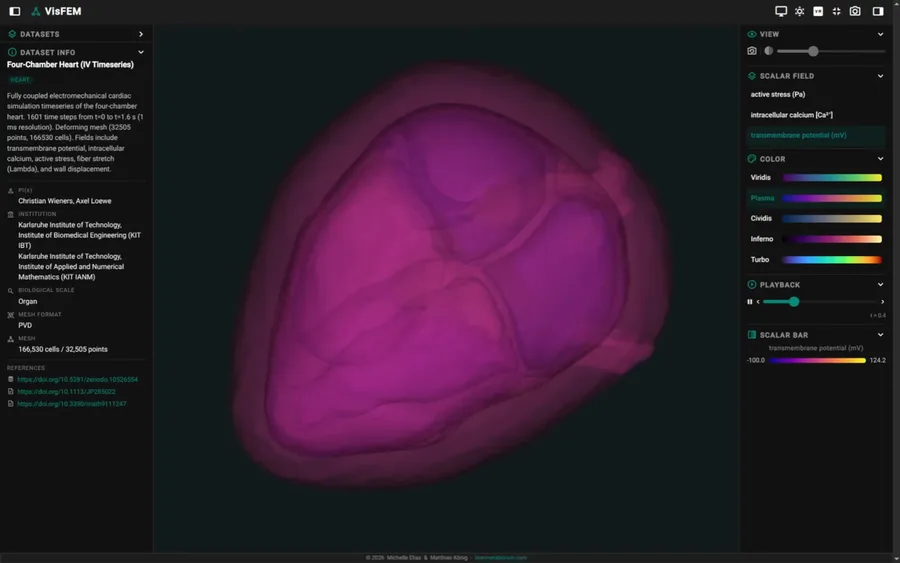
Web visualization of FEM models
A browser-based visualization tool for finite element method (FEM) simulation results, making FEM-based digital twin models interactively explorable and shareable directly from the web to lower the barrier to reproducible computational modeling.
0.2.0★ 21 open6 days agoPythonMIT

livermetabolism.com
Source of this website
The complete source of this website, with all research data (publications, people, projects, software, teaching) maintained as open YAML tables and built into a static site.
0.12.7★ 52 opentodayTypeScript
Nothing in this research area yet.
Data from GitHub, updated .
Funding

AI-Ready PK-DB: From Pharmacokinetic Data to Executable PBPK Models with Claude
Anthropic, Recipient, 09/2026–03/2027
$50,000
Developing an MCP server that lets AI agents navigate the pharmacokinetics database PK-DB from study to concentration-time profile and on to an executable PBPK model, making the database accessible to agents well beyond our own group. Awarded as usage credits for Claude.

X-Student Research Group - Digital Twins in Action: Optimizing Direct Oral Anticoagulant Use
BMFTR, Recipient, 10/2025–04/2026
€1,500
Project-based teaching initiative on digital twins in medicine, focusing on physiologically based pharmacokinetic (PBPK) modeling to optimize the use of direct oral anticoagulants.


AlgoNomy - Algorithmic Regulation Before Medical Liability - Advancing Doctor-Patient Autonomy in AI-Driven Healthcare
Circle U., Co-Investigator, 2024–2025
€10,000
Building an international academic network to investigate the role of algorithms and AI in medical decision support systems, with a focus on legal, ethical, and patient autonomy implications.
SPP2311 - SimLivA - SIMulation supported LIVer Assessment for donor organs
DFG, Recipient, 10/2025–09/2027
€895,500 (group share: €219,000)
Developing computational models and simulation workflows to assess liver function in donor organs, advancing predictive tools for transplantation and improving clinical decision-making.
X-Student Research Group - Physiologically based digital twins for the treatment of hypertension with ACE inhibitors and diuretics
BMFTR, Recipient, 04/2023–09/2023
€1,500
Project-based teaching initiative on digital twins in pharmacology, focusing on physiologically based pharmacokinetic (PBPK) modeling to optimize hypertension therapy with ACE inhibitors and diuretics.

ATLAS - AI and Simulation for Tumor Liver ASsessment
BMFTR, Recipient, 03/2023–12/2026
€1,530,550 (group share: €311,000)
Developing AI-driven and simulation-based methods to improve the assessment of liver tumors, integrating computational modeling with clinical data to support personalized diagnosis and treatment planning.
X-Student Research Group - Physiologically based modeling of drugs: ACE inhibitors in the treatment of high blood pressure
BMFTR, Recipient, 10/2022–03/2023
€1,500
Project-based teaching initiative on physiologically based pharmacokinetic (PBPK) modeling, focusing on optimizing the use of ACE inhibitors in hypertension therapy.
FOR5151 - QuaLiPerF - Quantifying Liver Perfusion-Function Relationship in Complex Resection – A Systems Medicine Approach
DFG, Recipient, 07/2021–11/2025
€3,825,000 (group share: €425,000)
Advancing systems medicine by developing computational models to quantify the relationship between liver perfusion and function in complex surgical resections, supporting risk assessment and personalized treatment planning.

EOSC-Life - Reproducible simulation studies targeting COVID-19
EOSC-life, Recipient, 06/2020–05/2021
€25,000 (group share: €5,000)
Developed reproducible computational simulation studies to investigate COVID-19 dynamics, integrating standardized workflows and open science practices for rapid and transparent research dissemination.
LiSyM - Systems Medicine of the Liver - Junior group leader - Multi-scale models for the personalized evaluation of liver function
BMFTR, Recipient, 06/2016–05/2022
€723,000
Led a junior research group developing multi-scale computational models to assess and predict liver function, advancing personalized medicine approaches and translational applications in hepatology.
Nothing in this research area yet.
This work was supported by the BMFTR-funded de.NBI Cloud within the German Network for Bioinformatics Infrastructure (de.NBI) (031A537B, 031A533A, 031A538A, 031A533B, 031A535A, 031A537C, 031A534A, 031A532B).
Editors
We are actively involved in the standardization and reproducibility efforts in Systems Biology and Systems Medicine.




Nothing in this research area yet.