Releases
Latest releases
- cy3sbmlv0.9.0
This release opens the model of a network in sbml4humans with one click, and reviews the code base: fixes, security hardening, cleanups, performance and documentation.
- sbml4humans0.9.0
Other tools open a model in SBML4Humans with an upload that has an address. cy3sbml, the SBML app of Cytoscape, uses it to open the model of a network with one click (cy3sbml#473). The release also closes several security gaps of the backend and of the frontend, and large reports load much faster.
- sbmlutils0.13.0
library code no longer prints: validation and flatten reports, the output of create_model(show_sbml=True), ReactionEquation.info(), xpp conversion headers, BioModels query progress, annotation results and Cytoscape information go to the sbmlutils. loggers at the matching level. Nothing is shown…
- libsbgnpy0.7.0
This release follows the latest SBGN specifications (PD L1V2.1, ER L1V2.0, AF L1V1.2) and validates documents against the rules of the specifications: the rules the schema cannot express, and the schematron rules of the SBGN languages, as the Java library libSBGN does.
- sbml2cellml0.4.2
libopencor is installed from PyPI with the simulate extra (#54).
- pkpdutils1.3.0
Minor release of pkpdutils which compares the non-compartmental analysis against the public benchmark suite of the NonCompart validation report (#103): all eight scenarios (theophylline and indomethacin, intravenous bolus, 0.25 h infusion and extravascular dose, linear and linear-up / log-down…
- pkdbv0.11.1
Simplify the REST API with study and measurement lists, typed advanced queries, consistent pagination, and authenticated dataset exports. The Python client now uses the v2 query and export routes (#822). · Make MCP strictly read-only: expose study search, canonical study retrieval, and scientific…
- livermetabolism-site0.12.3
A patch release that makes the colours of the network graph readable and lets a person carry research areas of their own.
- sbmlsim0.7.2
A patch release of the plotting: the axis labels of a figure, an inspection of the figure model and of its matplotlib rendering, and the citation.
- cobrapy0.32.1
fixed import failure when hopsy was not installed
- roadrunnerv2.10.0
Major new capability: variable stoichiometries.
- visfem0.1.0
first working prototype
- tellurium2.2.11.2
Small fix to SED-ML handling of files with paths. SimpleSEDML should now work on Windows.
Release history
Activity
Commit activity
Stars
- Python
- C++
- HTML
- Java
- JavaScript
- TypeScript
Software

PK-DB
Pharmacokinetics database
Developed the first FAIR-compliant open database for pharmacokinetics, integrating clinical and pre-clinical trial data. PK-DB enables reproducible PBPK/PD modeling, supports individualized simulations, and has become a key infrastructure for computational pharmacology research.
v0.11.1★ 5111 open4 days agoPythonMIT



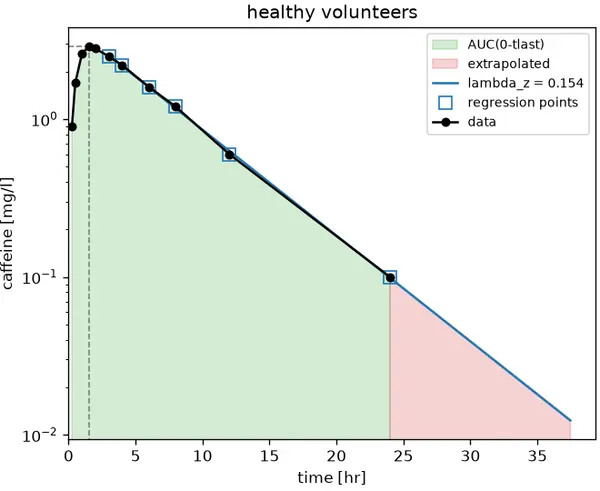
pkpdutils
PK/PD analysis in python
Developed a Python library for the pharmacokinetic and pharmacodynamic analysis of timecourses and parameters, from non-compartmental analysis and curve fitting to bioequivalence and meta-analysis. Formerly pkdb_analysis, the analysis toolbox of PK-DB.
1.3.0★ 50 open1 week agoPythonMIT

pkpdbib
PK/PD literature in python
Developed a Python library for working with pharmacokinetics and pharmacodynamics (PK/PD) literature and bibliographies, from retrieving the PDFs of a Zotero export to programmatic access to Zotero libraries. Supports the literature curation of PK-DB and of the PK/PD models built on it.


SBML4Humans
SBML simulation made easy
Designed an interactive reporting framework that makes SBML models human-readable and accessible, enabling experts and newcomers to explore model content without technical barriers.
0.9.0★ 213 openyesterdayPythonMIT

sbml2cellml
Conversion between SBML and CellML
Built a bidirectional converter between SBML and CellML 2.0, validating every conversion with libcellml and checking it by simulation against the SBML test suite and the curated BioModels. Lets models move between the two main model description standards instead of being locked into one.
0.4.2★ 10 open5 days agoPythonMIT
sbmlode
Ordinary differential equations of SBML models
Built a Python package that derives the system of ordinary differential equations of an SBML model from its reactions, rules, events and units, and writes it as simulation code for Python, Julia and R, verified against libRoadRunner over the SBML test suite, or as Typst, LaTeX and Markdown documents of the equations. The ODE export of sbmlutils as a package of its own.




roadrunner
High-performance simulator for SBML
Contributed to the development of libRoadRunner, a C/C++ library using LLVM for ultra-fast simulation of SBML models, setting a benchmark for performance in computational biology.
v2.10.0★ 6382 open1 month agoC++


tellurium
systems biology simulation library
Co-developed Tellurium, a Python-based environment for reproducible dynamical modeling of biological networks. Integrated standard formats with powerful simulation libraries, enabling accessible and transparent modeling.
2.2.11.2★ 146133 open1 month agoPythonApache-2.0
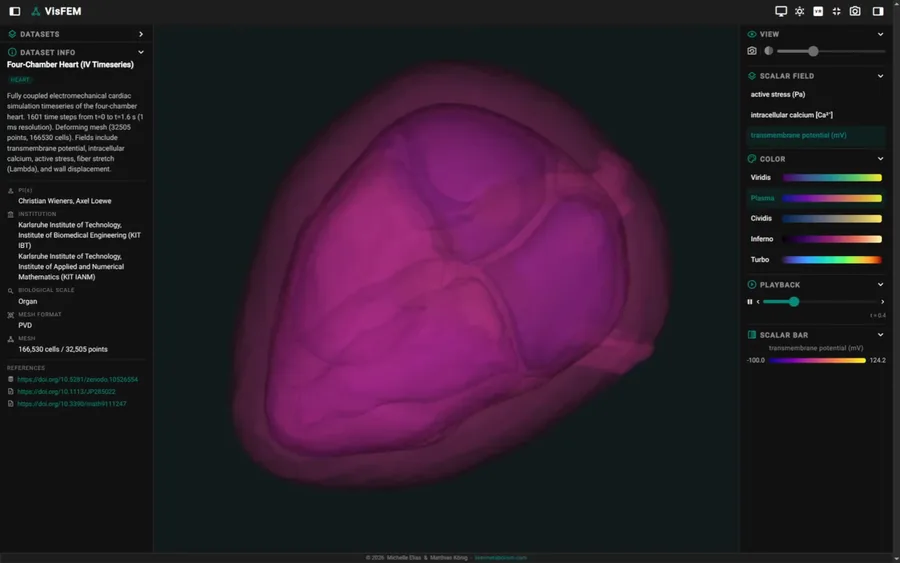
VisFEM
Web visualization of FEM models
A browser-based visualization tool for finite element method (FEM) simulation results, making FEM-based digital twin models interactively explorable and shareable directly from the web to lower the barrier to reproducible computational modeling.
0.1.0★ 10 open1 month agoPythonMIT

livermetabolism.com
Source of this website
The complete source of this website, with all research data (publications, people, projects, software, teaching) maintained as open YAML tables and built into a static site.
0.12.3★ 42 open2 days agoTypeScript
Nothing in this research area yet.
Data from GitHub, updated .
Funding

AI-Ready PK-DB: From Pharmacokinetic Data to Executable PBPK Models with Claude
Anthropic, Recipient, 09/2026–03/2027
$50,000
Developing an MCP server that lets AI agents navigate the pharmacokinetics database PK-DB from study to concentration-time profile and on to an executable PBPK model, making the database accessible to agents well beyond our own group. Awarded as usage credits for Claude.

X-Student Research Group - Digital Twins in Action: Optimizing Direct Oral Anticoagulant Use
BMFTR, Recipient, 10/2025–04/2026
€1,500
Project-based teaching initiative on digital twins in medicine, focusing on physiologically based pharmacokinetic (PBPK) modeling to optimize the use of direct oral anticoagulants.


AlgoNomy - Algorithmic Regulation Before Medical Liability - Advancing Doctor-Patient Autonomy in AI-Driven Healthcare
Circle U., Co-Investigator, 2024–2025
€10,000
Building an international academic network to investigate the role of algorithms and AI in medical decision support systems, with a focus on legal, ethical, and patient autonomy implications.
SPP2311 - SimLivA - SIMulation supported LIVer Assessment for donor organs
DFG, Recipient, 10/2025–09/2027
€895,500 (group share: €219,000)
Developing computational models and simulation workflows to assess liver function in donor organs, advancing predictive tools for transplantation and improving clinical decision-making.
X-Student Research Group - Physiologically based digital twins for the treatment of hypertension with ACE inhibitors and diuretics
BMFTR, Recipient, 04/2023–09/2023
€1,500
Project-based teaching initiative on digital twins in pharmacology, focusing on physiologically based pharmacokinetic (PBPK) modeling to optimize hypertension therapy with ACE inhibitors and diuretics.

ATLAS - AI and Simulation for Tumor Liver ASsessment
BMFTR, Recipient, 03/2023–12/2026
€1,530,550 (group share: €311,000)
Developing AI-driven and simulation-based methods to improve the assessment of liver tumors, integrating computational modeling with clinical data to support personalized diagnosis and treatment planning.
X-Student Research Group - Physiologically based modeling of drugs: ACE inhibitors in the treatment of high blood pressure
BMFTR, Recipient, 10/2022–03/2023
€1,500
Project-based teaching initiative on physiologically based pharmacokinetic (PBPK) modeling, focusing on optimizing the use of ACE inhibitors in hypertension therapy.
FOR5151 - QuaLiPerF - Quantifying Liver Perfusion-Function Relationship in Complex Resection – A Systems Medicine Approach
DFG, Recipient, 07/2021–11/2025
€3,825,000 (group share: €425,000)
Advancing systems medicine by developing computational models to quantify the relationship between liver perfusion and function in complex surgical resections, supporting risk assessment and personalized treatment planning.

EOSC-Life - Reproducible simulation studies targeting COVID-19
EOSC-life, Recipient, 06/2020–05/2021
€25,000 (group share: €5,000)
Developed reproducible computational simulation studies to investigate COVID-19 dynamics, integrating standardized workflows and open science practices for rapid and transparent research dissemination.
LiSyM - Systems Medicine of the Liver - Junior group leader - Multi-scale models for the personalized evaluation of liver function
BMFTR, Recipient, 06/2016–05/2022
€723,000
Led a junior research group developing multi-scale computational models to assess and predict liver function, advancing personalized medicine approaches and translational applications in hepatology.
Nothing in this research area yet.
This work was supported by the BMFTR-funded de.NBI Cloud within the German Network for Bioinformatics Infrastructure (de.NBI) (031A537B, 031A533A, 031A538A, 031A533B, 031A535A, 031A537C, 031A534A, 031A532B).
Editors
We are actively involved in the standardization and reproducibility efforts in Systems Biology and Systems Medicine.




Nothing in this research area yet.