Liver cancer is a significant cause of cancer-related deaths, and timely diagnosis and treatment are crucial for patient outcomes. Medical decision-making in this context is complex and requires consideration of multiple interdependent factors spanning various medical disciplines, past experiences, and clinical guidelines. Despite the availability of interdisciplinary tumor boards, finding optimal treatment pathways for individual patients remains challenging.
To address this issue, we propose the development of ATLAS, a decision support tool that leverages artificial intelligence (AI) to process patient data from various sources, including databases, systems medicine, and biomechanical in silico prognoses modeling data. In collaboration with experts in surgical oncology, mathematical modeling, and machine learning, we will use a co-design approach to integrate the tool's automated understanding of complex patient situations with expert knowledge and ontology-guided learning from retrospective cases of liver tumors.
ATLAS will be built on a large historical data cohort comprising over 6,000 patients with liver tumors, and evaluated through case studies at the Jena University Hospital. Our approach, which integrates medical expert knowledge, mathematical modeling, and AI, promises to yield high-quality diagnoses and treatments of liver tumors with patient-specific prognosis improvements. Furthermore, the scientific insights gained through this project offer the potential for transfer to malignancies in other organs, such as the lungs, kidneys, or brain.
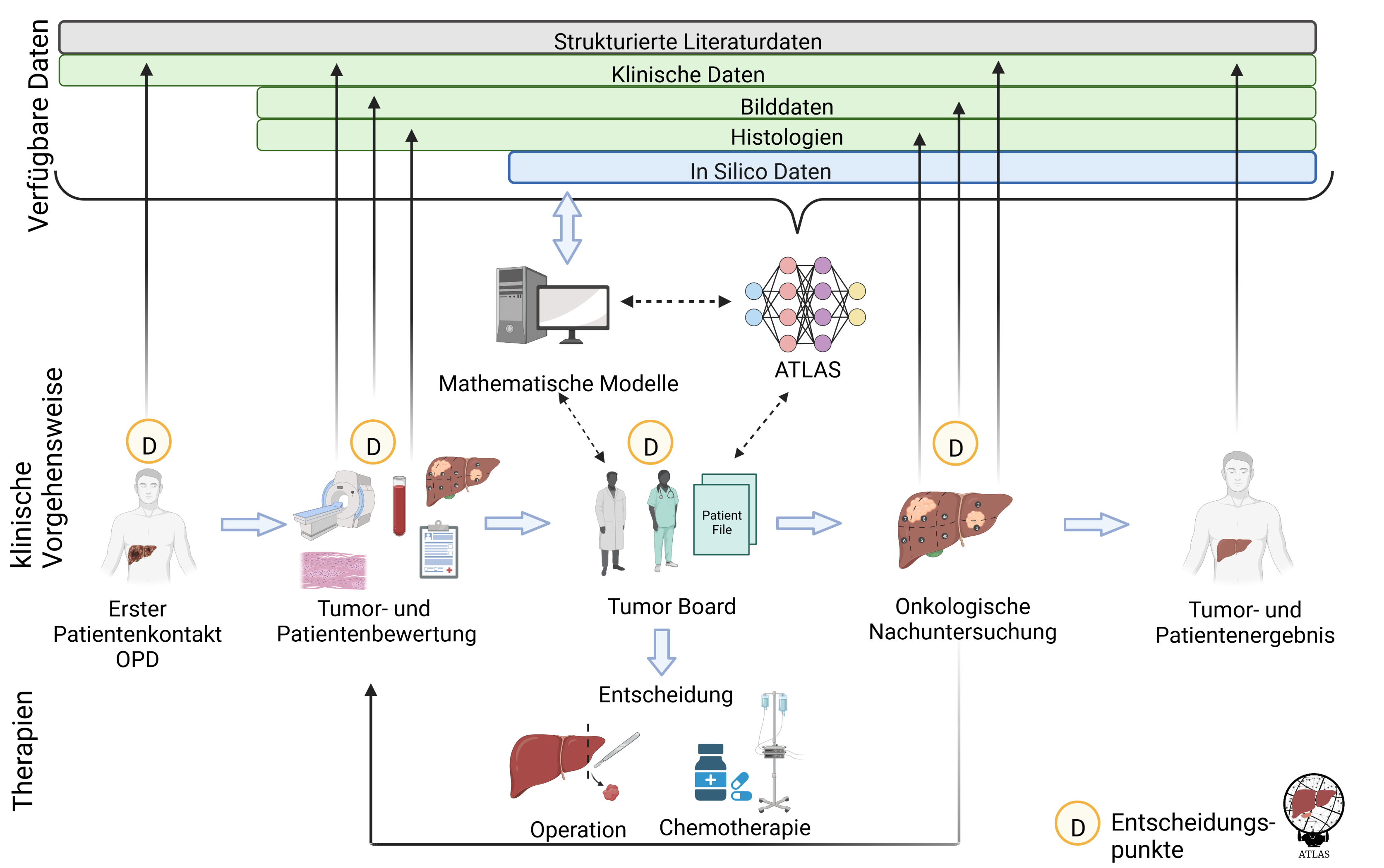
The development of ATLAS will not only provide clinicians with valuable decision-making support, but will also create a sustainable pathway for future commercial applications through tool and demonstrator development. Overall, this project represents a highly original and promising approach to improving outcomes for patients with liver tumors and has significant potential for wider medical applications.
ATLAS is funded via the BMBF programme „Computational Life Sciences“.